Everyone knows that, when it comes to cancer, early diagnosis is vital for survival rates.
The standard advice from healthcare professionals is that you should see your doctor if you notice a change that isn’t normal for you, or if you have any of the possible signs and symptoms of cancer.
But what happens if you think you spot the signs of a particular cancer in a loved one or in a friend and they haven’t mentioned it, or have mentioned it but haven’t taken any action to deal with it?
This is especially important if you already know that the person has a family history of cancer or has previously had cancer.
Symptoms
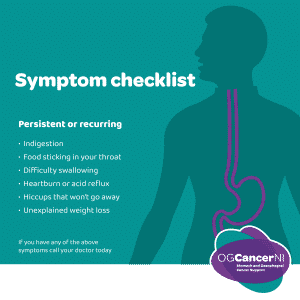
When it comes to gastric or stomach cancer, the problem is that the symptoms are often easily mistaken for other, less serious conditions, such as general indigestion, flatulence (wind) or constipation.
You may notice, for example, that they experience indigestion and stomach discomfort or a bloated feeling after eating. This may be accompanied by mild nausea, heartburn and a loss of appetite. Naturally, these symptoms are all ‘innocent’ in themselves.
If a loved one is experiencing these symptoms regularly, it’s a good idea to suggest that they see their GP anyway to see if there’s any way in which these uncomfortable and often distressing symptoms can be dealt with, particularly if the symptoms are affecting their daily life.
Irritable bowel syndrome, for example, can lead to bouts of alternating constipation and diarrhoea and this can make a loved one reticent about going shopping or visiting, through concern that they will experience an ‘episode’ outside, leading to embarrassment.
When to signpost a loved one to a GP
Where you need to have a serious conversation with a loved one, however, is if the symptoms begin to occur more frequently, are more serious in nature or if they begin to experience any of the following symptoms:
- Blood in their stools (poo)
- Vomiting
- Obvious weight loss without them trying to lose any
- Severe stomach pain
- Difficulty swallowing
Persuading them to see a GP
There’s no doubt that the word ‘cancer’ strikes fear in everyone. No matter how much medicine has improved over the years, cancer remains the one disease that can still prove incurable. For that reason, many people will ignore the symptoms and will choose to remain in denial even if they know that the symptoms they’re experiencing are not ‘normal’ for them.
If you see that a loved one is experiencing any of the symptoms above, or if they have expressed any concern about experiencing such symptoms, the first thing you need to do is provide reassurance that the best course of action is to act quickly. Reinforce the fact that, with cancer, early diagnosis will lead to the best outcomes.
Don’t dismiss their fears. They’re perfectly normal. But provide reassurance and gently persuade them to make an appointment with the GP as a first step. Reassure them that you’ll be with them every step of the way.
Remind them that, even if they’re worried about what the symptoms might be, they shouldn’t delay seeing the GP. Their concerns are not going to go away if they don’t make an appointment.
Remind them that the symptoms might not even be due to cancer, but, if they are, then the earlier it is picked up, the higher the chance of successful treatment.
Some patients worry that they’re wasting their doctor’s time, so, again, reassure them that that’s what the GP is there for – to provide reassurance that there is no illness present, or to deal with it if there is. Doing nothing is not an option.
Attend the appointment with your loved one
Once they do make an appointment with the GP, then tell them you’ll accompany them to it. This will not only give them some comfort that they won’t be alone, but will ensure that, in the event that they are extremely anxious, you’ll be in a position to provide the GP with all details of symptoms etc and can, if necessary, make notes.
It’s a good idea to write down their symptoms, including when they started, when they happen and how often your loved one has them.
List anything that makes the symptoms worse or better.
Make notes of any family history of cancer.
Ask the GP to explain anything that you or your loved one doesn’t understand.
Tests the GP may do at the appointment
At the appointment, the GP may carry out general tests to ascertain your loved one’s overall general health and will check for signs of cancer, such as lumps.
At that point, they may explain that your loved one doesn’t need a referral or any tests, or may suggest that they return in a few weeks if the symptoms continue or get worse.
If they suspect that there may be a serious problem, then they may refer the patient to hospital for tests.
In order for a diagnosis of gastric cancer to be made, the following tests and procedures may be used:
- Blood tests: you may then be referred testing
- A complete blood count will then be carried out. This involves a sample of blood being drawn and checked for the number of red and white blood cells and platelets
- An upper endoscopy may be carried out to look inside the oesophagus, stomach and duodenum (the first part of the small intestine) to check for abnormal areas. In some cases your GP may send you for this scope if you have some of the early symptoms. At this point, an endoscope (a thin, lighted tube) is passed through the mouth and down the throat into the oesophagus.
When it comes to suspecting that a loved one might have gastric cancer, the most important thing is to encourage them to act quickly.